

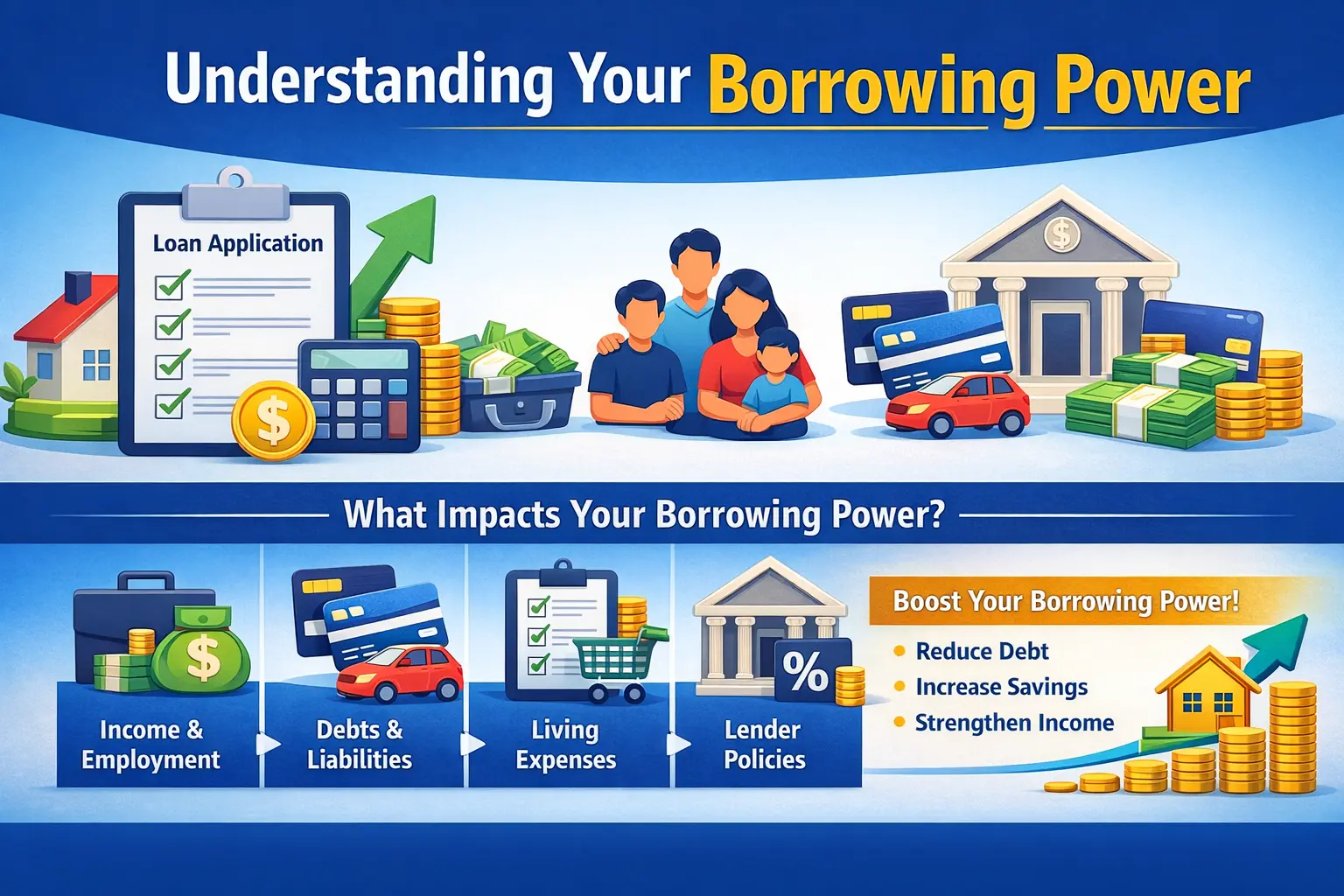
Key Takeaways
- Borrowing capacity is the approximate maximum a lender may approve, based on your income, expenses, debts, and overall financial position.
- It can differ a lot between lenders because each one uses different rules, buffers, and income calculations.
- You can often improve your result by reducing liabilities, strengthening savings, or setting up the right loan structure.
- Loan Lodge can help you work out your true borrowing range, improve it where possible, and use it strategically so you can purchase with confidence.
What Does “Borrowing Capacity” Mean?
Borrowing capacity (often called borrowing power) is the amount a bank or lender is willing to lend you for a home loan, based on whether you can repay it under stress-tested conditions.
It’s not just “what you think you can afford” — it’s what the lender believes you can handle if conditions change.
What Lenders Look At
When assessing borrowing capacity, lenders commonly consider:
- Income (salary, rental income, bonuses, overtime, commissions, etc.)
- Living costs and household size (including dependants)
- Existing debts (credit cards, car loans, personal loans, HECS/HELP, BNPL limits, etc.)
- Loan term and proposed repayment period
- The interest rate used for assessment (often higher than the rate you’ll actually pay)
How Borrowing Capacity Is Calculated
Every lender has their own model, but most calculations include:
Gross income (before tax)
Income is reviewed for stability and consistency — and not all types of income are treated equally.
Living expenses
Lenders use either your declared expenses, a benchmark minimum, or a mix of both.
Current debt commitments
Existing debts reduce what you can borrow. Credit cards are a big one — lenders usually assess them based on the limit, not the balance.
Assessment buffers
Even if your actual interest rate is lower, lenders often assess repayments at a higher “buffered” rate (commonly a few percent above current rates). This reduces the maximum loan amount you’re approved for compared to “real-world” repayments.
Why Different Lenders Give Different Answers
Two lenders can produce very different borrowing figures using the same financial information, because of differences like:
- How they treat overtime, bonuses, commissions, and casual income
- Their assumptions for household spending based on family size and location
- Their maximum debt-to-income (DTI) tolerances
- How strict they are on liabilities like credit cards and other commitments
That’s why “one calculator result” doesn’t always tell the full story — lender choice matters.
Ways to Increase Your Borrowing Capacity
In many cases, your borrowing position can improve with a few changes:
- Reduce existing debts (or refinance them into a lower commitment)
- Lower unused credit card limits (even if you rarely use them)
- Strengthen income evidence (consistent overtime/bonuses, stable rental income, etc.)
- Tighten spending habits (some lenders check transaction histories)
- Avoid new liabilities before applying (car finance, BNPL accounts, new credit enquiries)
- Add a co-borrower where appropriate to combine incomes
Even one or two adjustments can make a noticeable difference depending on the lender’s servicing model.

Tools to Estimate What You Can Borrow
Online calculators are a useful starting point — but they often miss lender-specific rules.
A broker-style assessment can help you understand:
- A realistic borrowing range (not just one number)
- Which lenders are most suitable for your situation
- What conditions may apply (like LVR, DTI, income evidence, etc.)
Want to Know Your Real Borrowing Range?
At Loan Lodge, we can help you:
- Compare your borrowing capacity across multiple lenders
- Understand what’s helping or hurting your maximum loan amount
- Put a plan in place to improve your borrowing position over time
📞 0432 883 436
🌐 https://loanlodge.com.au